1. This Isn't Theory — It's Already Happening
Walk into any convenience store in Nigeria today, and alongside Indomie's familiar green packaging, you'll see more and more local brands claiming shelf space — Master Noodles, Doyin Noodles, Chikki, and others.
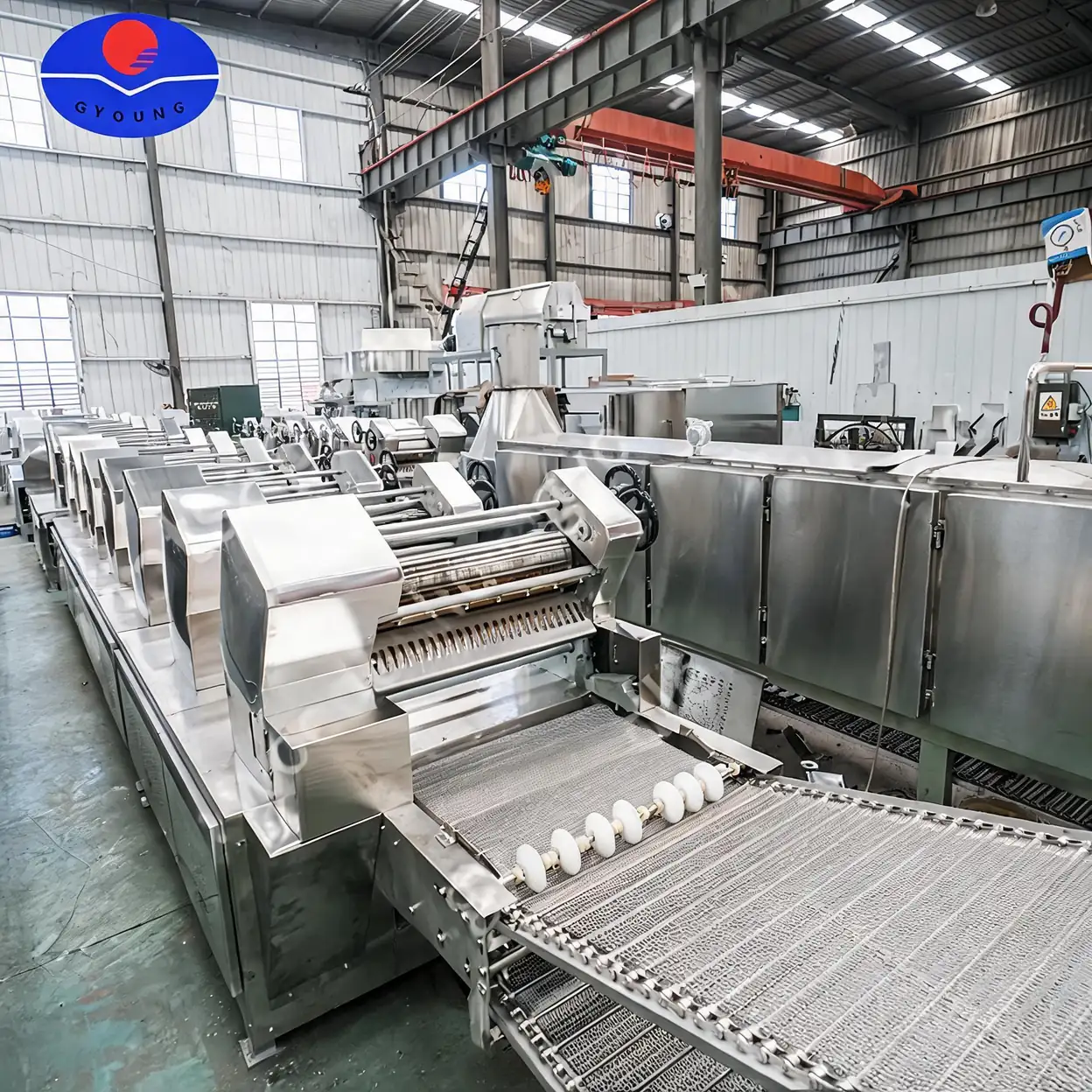
These brands share a common story: Chinese instant noodle production lines are powering their growth.
Over the past several years, GYOUNG has delivered 10+ noodle production lines to Nigeria, Zambia, Poland, Nepal, and beyond — supplying equipment to leading local manufacturers including Master Noodles and Doyin Noodles.
2. Three Configurations — One Fits Your Budget
| Scale | Investment | Capacity | Footprint | Staff | Best For |
|---|---|---|---|---|---|
| Small | Contact for a tailored quote | 20–50K packs/day | ~500m² | 2–3 | Market testing / regional sales |
| Medium | Contact for a tailored quote | 50–100K packs/day | ~1,000m² | 2–3 | Single city / state coverage |
| Large | Contact for a tailored quote | 100K+ packs/day | ~1,500m² | 2–3 | Nationwide distribution / export |
Recommended for first-time investors: Medium line (50–100K packs/day) — the sweet spot between flexibility, cost, and scalability. It delivers enough volume to compete on price while keeping initial capital outlay manageable.
3. Why Chinese Equipment Is the Go-To Choice for Africa
① Cost leadership
Chinese noodle production lines offer unbeatable value. FOB pricing is typically half (or less) of comparable European or Japanese equipment, while delivering the same core functionality for standard instant noodle production.
② 15-year lifespan — double the industry average
GYOUNG lines use food-grade 304 stainless steel for all product-contact components, designed for 15+ years of service, versus the industry norm of 7–8 years. One line can carry you through two full business cycles.
③ Fully adapted for African conditions
- Power-tolerant: Compatible with diesel generator + solar backup configurations, designed to handle voltage fluctuations common in African markets
- Multi-flour compatible: Handles wheat, cassava, and sorghum flour — supporting local raw material substitution to reduce costs
- Bilingual O&M: English manuals and on-site operator training by Chinese engineers
④ Turnkey delivery
From factory layout design to installation, training, and after-sales support — Chinese suppliers like GYOUNG provide a true end-to-end solution. You don't need to source components from multiple vendors or coordinate different contractors.
4. From Order to Production — The Full Timeline
Total time from order to first production: approximately 7 months. This includes manufacturing, shipping, customs clearance, installation, and training.
5. Even Dangote Chose Chinese Equipment
Dangote Group — Africa's largest conglomerate — uses Chinese-made noodle and pasta production lines for its food processing business. That alone sends a powerful signal: Chinese equipment has earned the trust of Africa's most demanding industrial buyer.
| Brand | Positioning | Strategy |
|---|---|---|
| Master Noodles | Mid-low end | Affordable pricing + localized flavors, deep regional distribution networks |
| Doyin Noodles | Mid-range | Quality-driven brand, covering Lagos, Abuja, and other core urban markets |
| Dangote Noodles | Full category | Group brand power + pan-African distribution network, economies of scale |
These success stories demonstrate a clear pattern: Chinese noodle production lines provide the right balance of cost, reliability, and scalability for African market conditions.
6. Why GYOUNG — What Sets Us Apart
- Proven African track record: 10+ production lines delivered across Nigeria, Zambia, and other African markets
- Genuine 304 stainless steel: All food-contact parts use 304 stainless steel — 2× the industry average lifespan
- 7 precision rolling stations: 7-group high-precision calender rolls ensure uniform dough sheet thickness, delivering a finished product rate above 98%
- Modular design: Fast installation, simple operation, 1–2 workers can manage the entire line after training
- Flexible payment: T/T, L/C at sight, and other payment terms available to support different market needs
- On-site installation & training: Chinese engineers fly to your factory for installation, commissioning, and hands-on operator training
- 1-year warranty + lifetime support: Common spare parts shipped with the equipment; 24/7 technical support via WhatsApp/WeChat
Frequently Asked Questions
What capacity noodle production line is best for a new factory in Africa?
For first-time investors in Africa, we recommend a medium-scale line producing 50,000–100,000 packs per day — contact us for a tailored equipment quote — requiring a ~1,000m² factory space. This capacity hits the sweet spot: enough volume to achieve competitive unit costs, serve a single state or major city profitably, and scale up as your distribution grows. Smaller 20,000–50,000 packs/day lines are available for regional market testing.
Can your noodle lines use local raw materials like cassava flour?
Yes. GYOUNG noodle production lines are specially engineered to be multi-flour compatible, supporting blends of wheat flour with locally sourced cassava flour, sorghum flour, and other African starches. This flexibility helps manufacturers reduce reliance on expensive imported wheat, lower FX exposure, and qualify for Nigerian government local procurement tax incentives while maintaining noodle texture and quality consumers expect.
How many workers are needed to operate a full instant noodle production line?
A complete GYOUNG instant noodle production line, regardless of scale (small, medium, or large), requires only 2–3 trained operators per shift. Our modular, automated design simplifies dough feeding, rolling, steaming, cutting, frying, cooling, and stacking processes. We provide comprehensive hands-on training for your staff during installation, so your team can independently run production after our engineers depart.
Do you provide turnkey factory design and installation services?
Absolutely. GYOUNG provides a true end-to-end turnkey solution: starting with free factory layout design based on your available space and capacity goals, through equipment manufacturing, sea shipping, on-site installation by Chinese engineers, commissioning, full operator training, and lifetime technical support. The full timeline from order to first production is approximately 7 months. We also supply a starter kit of common spare parts with every line delivery.
What payment terms do you offer for African buyers?
We support flexible payment terms including T/T (30% deposit to start production, 70% before shipment) and irrevocable L/C at sight, which is a popular option for African buyers. For established clients with repeat orders, we can discuss milestone-based payment structures on a case-by-case basis. Contact our sales team via WhatsApp for a customized quotation and payment plan tailored to your project.
Ready to plan your noodle factory?
Contact GYOUNG CHINA for a free factory layout proposal, equipment quotation, and customized investment solution. We've helped 10+ African investors launch successful noodle brands.
📩 Get a Free QuoteReferences:
- Business Post Nigeria — Extensive Distribution Network, Promotional Activities Buoy Indomie 60% Noodles Market Share (June 10, 2026). GCR Ratings report: Indomie (Dufil Prima Foods) 60%+ market share; Dufil FY2025 revenue NGN 1.1 trillion.
🔗 https://businesspost.ng/... - World Instant Noodles Association (WINA) — Global instant noodle consumption reached 120.21 billion servings in 2023. Nigeria ranks among the top 10 markets worldwide.
- The Business Research Company — Instant Noodles Market Report 2026. Global market grew from $61.52B (2025) to $66.81B (2026), CAGR 6.9%.
🔗 https://www.researchandmarkets.com/... - US International Trade Administration (trade.gov) — Nigeria applies ECOWAS Common External Tariff; high duties on finished food products strongly favor local manufacturing.
🔗 https://www.trade.gov/...